Choosing Between a 20 Foot and 40 Foot Container
The obvious way to choose between a 20-foot and a 40-foot container is to ask how much space you want and pick the bigger one if in doubt. It’s also the wrong way, or at least an incomplete one. The two sizes share the same width, so a 40-foot box doesn’t give you a bigger room in the way most people imagine. It gives you a longer one. Whether that length helps depends entirely on what you plan to do inside, and on whether a truck long enough to carry it can actually reach the spot where it’s going to sit.
Start with what the names mean. Twenty feet and forty feet are external lengths, and the international standard for freight containers classifies boxes by their outside dimensions so that they stack, lock and travel together anywhere. A 20-foot box is about 6.06 metres long outside and a 40-foot box about 12.19. Both are 8 feet wide, roughly 2.44 metres, and a standard box is 8 feet 6 inches tall, about 2.59 metres. The high cube is the tall version, a foot higher at 9 feet 6 inches, about 2.90 metres. High cubes are most common in the 40-foot length, though 20-foot high cubes exist too.
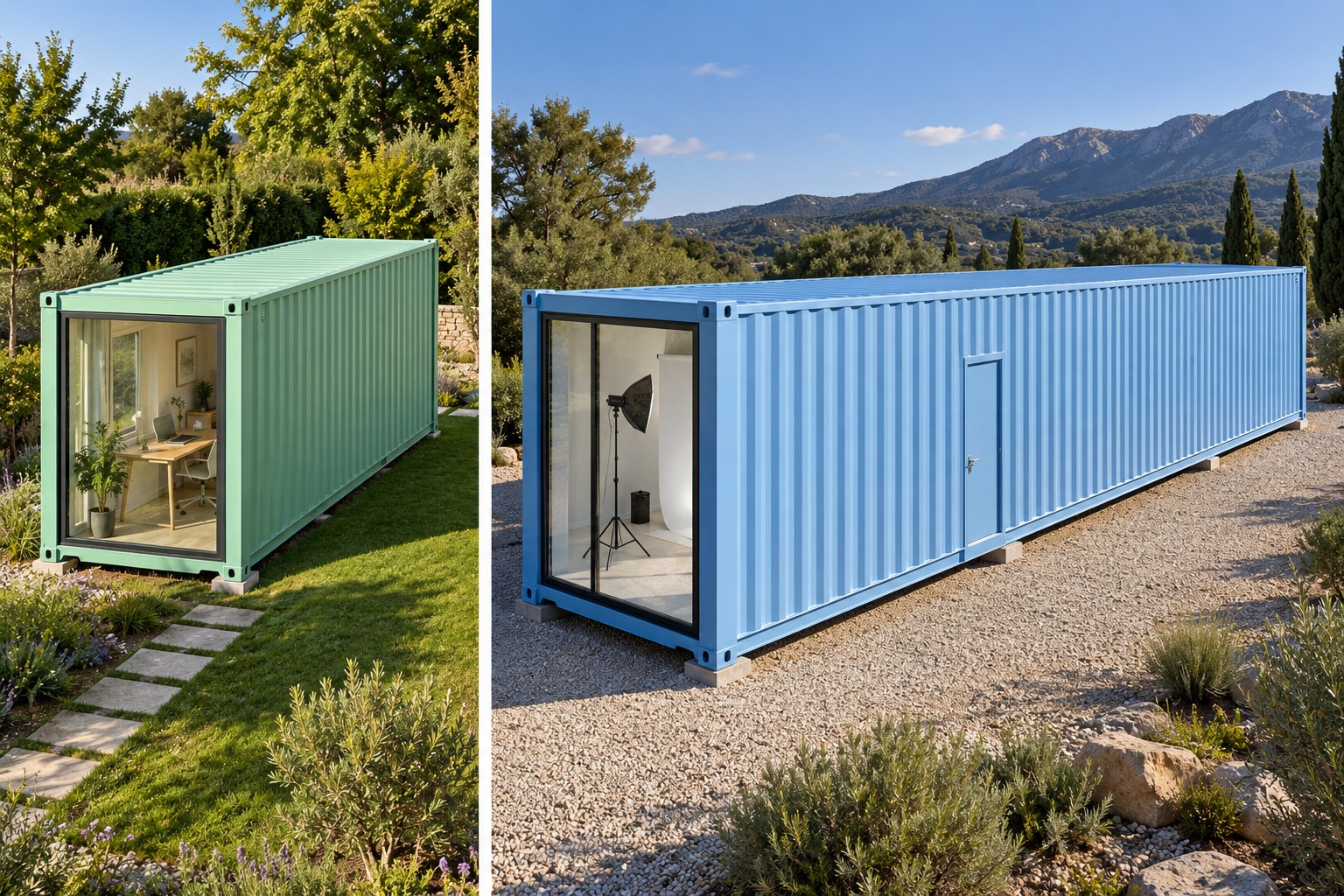
Image credit: pxef.com. AI-generated design concept. These separate proposals are illustrative views, not a scale comparison.
Inside is where the numbers start to wander. Shipping lines and leasing companies publish internal dimensions, and they mostly agree but not exactly. Several list a 20-foot standard box at about 5.90 metres long, 2.35 metres wide and 2.39 metres high. For the 40-foot standard, the figures are about 12.03 metres long with the same width and height. A 40-foot high cube adds roughly 300 millimetres of internal height, coming in at about 2.70 metres. One major line lists its high-cube width at 2,342 millimetres while others say 2,352, and one forwarder’s older sheet lists a 40-foot standard at 2,383 millimetres high instead of the more usual 2,393. Door openings vary too, by a little over 10 millimetres in height between sources. Use the brochure to shortlist a shell, then obtain its actual specification and measure the unit before designing the fit-out. Door markings and safety plates provide important identification and weight information, but they are not a measured survey of the usable interior.
Weight matters more than people expect, because it decides how the box can be delivered and what it sits on. Published tare weights, meaning the empty container, run from about 2,180 to 2,350 kilograms for a 20-foot standard, about 3,640 to 3,750 for a 40-foot standard, and about 3,750 to 3,940 for a 40-foot high cube. Converted, with linings, glazing and fittings, all of those numbers go up, and the foundation or supports have to be designed for the finished building, not the empty shell.
Now the conversion. To compare like with like, use the same illustrative wall allowance for every size: 75 millimetres of insulation and lining on each side and the closed end, 150 millimetres at the door end for a new glazed screen, 60 millimetres of floor build-up and 75 of ceiling. A 20-foot standard box finishes at about 5.68 by 2.20 metres with 2.26 metres of headroom, roughly 12.5 square metres. A 40-foot standard finishes at about 11.81 by 2.20 metres, roughly 26 square metres, with the same 2.26 metre ceiling. A 40-foot high cube gives the same floor area with about 2.57 metres of headroom. These are planning figures, not a specification. A real wall assembly might be thinner or much thicker, and every millimetre on the walls comes off that 2.20 metre width.
The width is the same for all three. That’s the fact that should drive the decision. The longer shell gives a little over twice the floor area under these allowances, but every room inside is still about 2.2 metres across. A 40-foot container cannot accommodate a four-metre-wide backdrop across its width. A narrow meeting table or bed may fit, but the chair pull-out space and routes beside it still have to work within the same tight cross-section. It gives you a long room, or two rooms in a row, or one room with a lot of storage behind it.
So think in task zones laid along the length. A one-person office needs about a metre at the door for coats and arrival, a couple of metres of desk run, some space to step away from the screen, and a solid wall at the far end for storage and services. That fits comfortably in about 5.68 metres. Putting the same office into a 40-foot box doesn’t make it better. It just leaves six metres of floor you’re paying to heat, light and maintain. A small photography studio is the opposite case. It needs a long axis for camera distance and background separation, a separate editing zone and somewhere to keep stands and paper. Those things string out along the length naturally, and a 40-foot high cube suits them, with the extra 300 millimetres of headroom helping with lights. Storage sits between the two. A 20-foot box with an aisle down the middle holds a lot of garden and household kit, and a 40-foot box provides roughly twice the floor area but puts the far end about twelve metres from the doors. Usable storage capacity still depends on the racks, loading and retrieval space. Things at the back of a long store tend to stay there.
Height deserves its own moment. A 2.26 metre finished ceiling may suit some office, storage or workshop uses, but equipment clearance, comfort and local requirements need checking. It is a poor starting point for tall equipment or a sleeping mezzanine; even a high cube does not automatically make a second sleeping level workable. The high cube’s extra 300 millimetres is often worth more than the extra length, and it’s available on 20-foot boxes too, though less commonly.
Then there’s getting it there. This is where many 40-foot plans quietly die. Container suppliers publish delivery requirements, and while their figures differ, the pattern is consistent. A tilt-bed truck that slides a 20-foot box off the back typically needs something like 18 metres of straight, clear approach. For a 40-foot box the same suppliers quote somewhere between about 30 and 37 metres, plus clear height above as the box tilts. Side-lifter trucks set the box down beside the vehicle and need less straight run but more width, firm ground and room for their legs. A narrow drive, a garden gate, overhead cables or a soft lawn can rule out a 40-foot box entirely, or turn its delivery into a crane job that costs more than the container. The delivery company should see the site before anyone pays a deposit.
Condition and grade terms deserve a quick warning. Phrases like one-trip, cargo-worthy and wind and watertight are trade descriptions used by sellers. They aren’t a single published standard, and different sellers apply them differently. Ask what the description means for the particular box being sold, and look at it.
So which size? Choose the smallest box whose length fits the task zones you’ve actually drawn, at the finished width, with the ceiling height those tasks need. For one person and a desk, that is usually a 20-foot box. For a long, single-axis activity, a 40-foot high cube makes sense. For storage, the size that keeps the far end within reach. If none of them fit because the task needs width, a container is the wrong building, and a longer one won’t change that.