Storage That Does Not Become a Steel Box Full of Regret
Every storage container starts life as the tidiest place on the property. The mower goes in first, then the garden chairs, then a few boxes from the loft, then the camping gear that has no other home. Two summers later, getting to the hedge trimmer means unloading half the contents onto the lawn. The cushions smell faintly of damp, something has chewed through a bag of bird seed, and a padlock that looked solid turns out to be the weakest part of a very strong box. None of that happens because containers are bad at storage. It happens because nobody planned what goes where, or what each of the three slow enemies needs.
This concept is a plain 20-foot container used as a non-habitable store for a household with a large garden. It holds a compact manual push mower and the hand tools used every week in season, then the seasonal kit used a few times a year, like garden furniture cushions, a gazebo and camping equipment, and finally the true archive, boxes of decorations and replaceable household spares that come out once a year if at all. Nobody works in it and nobody sleeps in it. There is no desk, plumbing or sleeping space to fit in, but the retrieval route still deserves a proper plan. Storage is not the absence of design; it is a different brief.
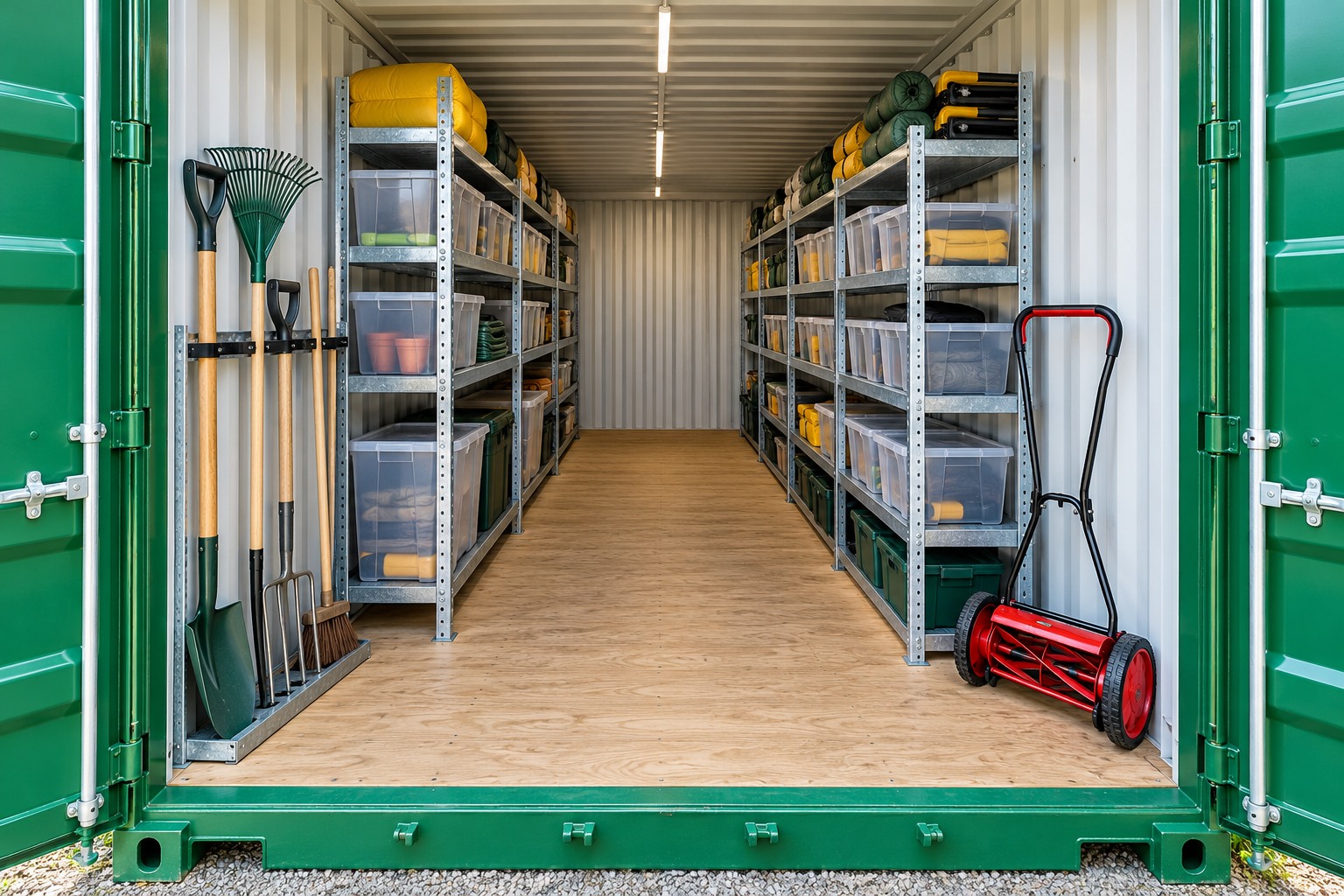
Image credit: pxef.com. AI-generated design concept.
For this particular proposal the box stays unlined, which limits the contents it can sensibly protect. Non-habitable use by itself does not establish that bare steel will suit every stored item or climate. One shipping line lists a standard 20-foot container at about 5.90 metres long, 2.35 metres wide and 2.39 metres high inside, with a door opening of about 2.34 by 2.29 metres. Those figures are nominal and vary between manufacturers, but they give a good starting point. Galvanized boltless shelving comes in standard depths, and this plan uses a 600 millimetre run along the left wall for the heavier bins and a 500 millimetre run on the right. The layout allows an illustrative 30 millimetres behind each rack for the wall profile and its installation; the actual gap and restraint need to follow the selected shelving and container details. That leaves an aisle of roughly 1.19 metres down the middle, before allowing for protruding contents or hardware. Check that against the actual mower, the largest carried bin and the person moving it. It is a planning calculation, not a measured aisle in the illustration or a guarantee of turning space.
The layout follows one rule: the more often something is used, the closer it lives to the doors. The first 1.5 metres inside the doors have no shelving on the right-hand side. That’s where the compact mower parks along the side, leaving the central approach clear so it can be wheeled out without moving a bin. On the left, long-handled tools hang on a shallow wall rack only 150 millimetres deep, so a spade can be lifted off a hook without moving anything else. Shelving starts after that and runs to the back wall. The first two metres of shelving hold the seasonal kit in clear, uniform bins, one bin deep, with the contents facing the aisle. The last 2.4 metres hold the archive. Nothing is stacked in front of anything else, and the aisle runs all the way to the back. Fetching the box of decorations from the far corner in December means walking past everything else, not moving it.
Height matters as much as distance. Items that are both heavy and used often should be accessible without overhead reaching, deep bending or pulling a load out at arm’s length. Australia’s Comcare guidance places heavier shelf contents between knee and knuckle height to reduce handling demands, but the right arrangement depends on the person and load. Avoid storing paving slabs or a bag too heavy to handle simply because a shelf is rated to carry it. This proposal puts manageable heavier bins low and light bulky items higher, rather than piling heavy boxes above safe reaching height. Check shelf and bay ratings, load distribution and the condition of the floor; a generic photograph cannot establish capacity. The racks need suitable bracing and restraint, with any connection to the container properly specified rather than assumed to be a screw into thin corrugated sheet.
Now the three enemies, which are worth keeping separate because each has its own fix.
Moisture is the one people underestimate. The German insurers’ Container Handbook describes how daytime heating and night cooling can drive moisture out of hygroscopic contents and onto a container’s cold steel surfaces, with roof condensate eventually dripping onto cargo. Its examples concern freight, so they are a warning about the mechanism, not a prediction of this garden store’s humidity. Damp tents, wet cushions, grass on tools and wet packaging are all avoidable moisture inputs. Dry contents before storage and inspect for roof leaks, damaged seals and signs of condensation. Keep dry goods protected appropriately, but do not seal damp fabric in a bin and expect the lid to solve it. A cover is not a substitute for a dry storage environment.
Vents, desiccants and a moisture-resistant bin solve different parts of the problem. Their usefulness depends on the contents, air conditions, maintenance and the actual enclosure; none is a universal cure. A temperature and humidity record, together with inspection after cold nights and wet weather, is more useful than assuming an empty desiccant tub is still working. The supports and site drainage need checking for the actual unit, but lifting it off the ground does not by itself prevent roof condensation. Irreplaceable papers, photographs or sensitive textiles do not belong in an uncontrolled store merely because they fit on a shelf. If those items are the main brief, choose more suitable storage rather than adding another gadget.
Pests come next. The U.S. Centers for Disease Control and Prevention notes that mice can enter a pencil-width opening, around six millimetres, which makes worn door seals and service penetrations worth inspecting. Repair unintended gaps with suitable durable materials, while preserving any ventilation that the design requires; blocking every opening indiscriminately is not a moisture strategy. Keep bird seed and animal feed in robust containers with tight lids, clean spills promptly and check for damage. A translucent bin that makes the inventory easy to see is not necessarily rodent-resistant. The bin specification needs to match what it holds.
Security is the third enemy, and the box is less secure than it looks. The shell is only part of the enclosure: the doors, hardware and any exposed padlock also need attention. A compatible lock shroud can reduce direct access to a padlock, but its effectiveness depends on the doors, hardware, fixings and installation. It is one part of a security plan, alongside site visibility, lighting where appropriate, suitable locks, property records and any restraint for valuable equipment. Do not assume that hiding an item at the back makes it secure. The frequency rule still matters: the weekly mower belongs near the door, while less-used valuable kit may sit farther back. Any anchor point needs a suitable load path and fixing detail, rather than a chain attached to an arbitrary part of the floor. Plan restraints so they do not become an obstruction when someone enters.
The manual mower in this concept deliberately avoids introducing fuel storage or a charging station. If the equipment changes to petrol or battery power, revisit the brief rather than assuming the same cupboard is suitable. Follow the equipment manufacturer’s storage and charging instructions and the applicable local requirements, with a suitable place for any fuel or batteries. Those are separate decisions from choosing the shelf spacing.
Would a timber shed do this better? A well-designed shed may offer a more convenient shape, windows and a different approach to moisture control. It still needs weather protection, a suitable base, maintenance and security; timber buildings can have condensation problems too. A container offers a robust reusable shell, but its condition, transport cost and conversion details matter more than a blanket claim about longevity or theft resistance. It only wins on usefulness if the layout keeps an aisle open and the owner treats moisture, pests and security as three different problems.