A Bicycle Workshop Built Around the Repair Stand
A bicycle is an awkward thing to fit into a narrow room. It’s about as long as a person is tall and as wide as its handlebars, and when it’s clamped in a repair stand it hangs at chest height where you can’t step over it. Most home bike workshops grow by accident around that awkwardness. The stand goes wherever there’s space, the waiting bike leans against whatever’s free, and the person fixing the gears spends half the evening squeezing round both. A shipping container makes that problem impossible to ignore, which is the best thing about it.
This concept puts the stand first and builds everything else around it. Picture a household with four bikes, one of them a heavy cargo bike, whose owner also helps friends from a local cycling club keep their bikes running. It’s a hobby, not a shop, and nothing here suggests otherwise. The work is cleaning, adjusting, replacing chains and cables, truing wheels and fitting new parts. It needs one repair stand, a lot of small parts within reach, somewhere secure to keep the bikes, and a place to wash them that isn’t the kitchen.
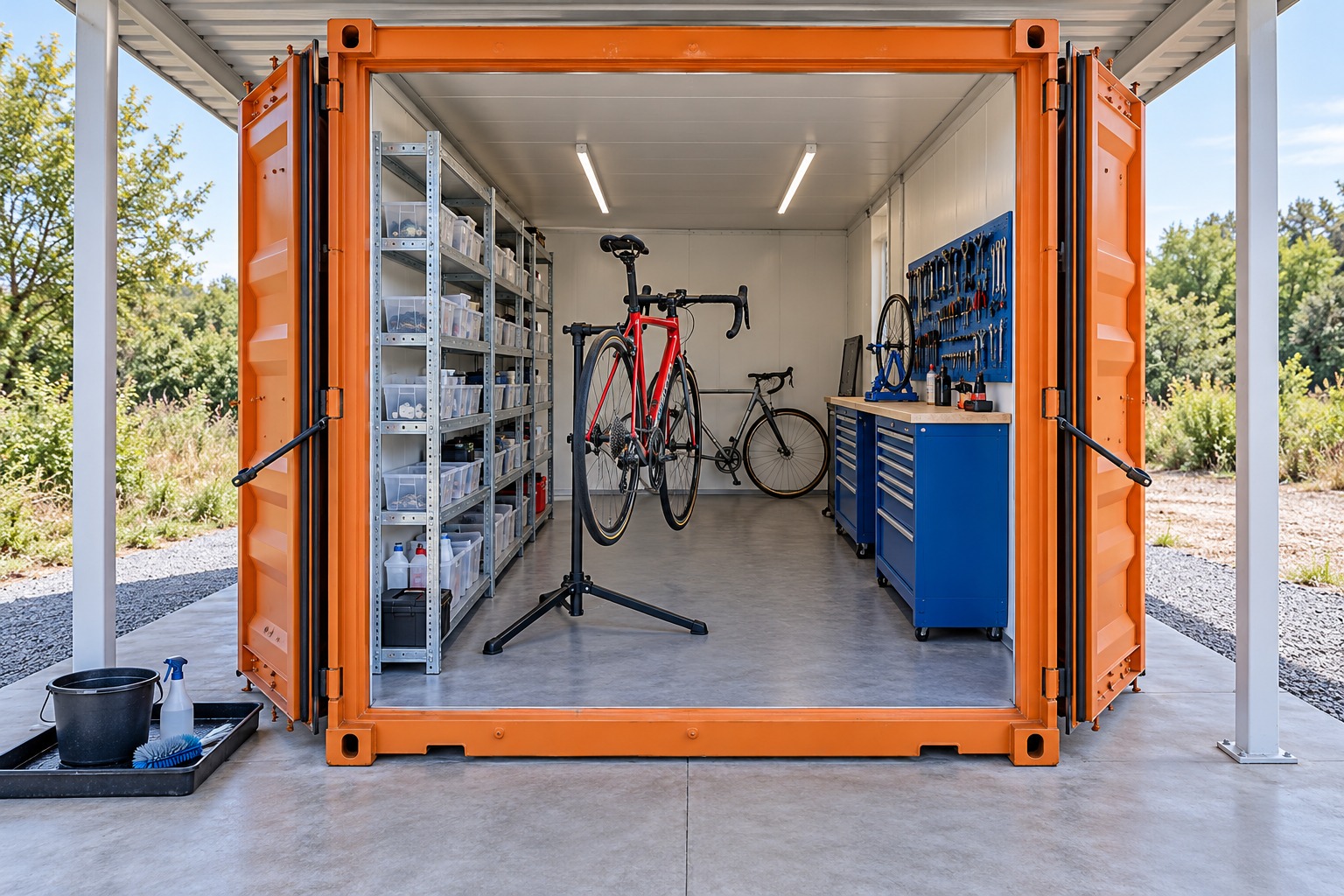
Image credit: pxef.com. AI-generated design concept. Stand placement and movement clearances require checking with actual equipment.
Start with the bicycle itself. Britain’s cycle infrastructure design guidance treats an ordinary upright bike as about 1.8 metres long and 0.65 metres wide at the handlebars, with cargo and adapted cycles up to 2.8 metres long. The shell is a standard 20-foot container, about 5.90 metres long and 2.35 metres wide inside according to one shipping line’s nominal figures. With an illustrative 75 millimetres of insulation and lining on each side and the closed end, 150 at the door end, 60 for the floor and 75 for the ceiling, the finished room is roughly 5.68 metres long and 2.20 metres wide, with about 2.26 metres of headroom. Those dimensions describe a space allowance, not a tested moisture-control assembly.
A bike fits across that width, just. That’s why this design runs it along the length. A home-mechanic repair stand from one well-known maker spreads its three legs over a triangle a little over a metre on its longest side and holds a compatible bike at the approved clamping point at somewhere between about 1.0 and 1.5 metres high. Set the stand in the front half of the container, about 2.4 metres in from the doors, and clamp the bike so it lies along the room. The handlebars and wheels now sit roughly in the middle of the width. Along most of the bike’s length, the frame itself is narrow, but the stand legs, pedals, tools and the mechanic still occupy the surrounding floor. The tight spot is at the handlebars, where the gap on each side drops to a bit over half a metre. That is a static gap between assumed objects, not a verified passage or escape width. A full-size mock-up needs to include the actual stand footprint, pedals, handlebar sweep and person at work. A clamped bike must not block the only exit.
The left wall carries the vertical parts storage. Tall galvanized racks, 400 millimetres deep, run from just inside the doors for about three metres, filled with clear bins of tubes, cables, brake pads, chains and the hundred small things a bike eats. They sit beside the stand, so a part is one step away from the bike it’s going on. Hand tools hang on a board above the bench further back. The right side of the repair zone stays clear, because that’s where the mechanic stands most of the time and where a wheel comes out and goes back in.
Further in, the right wall gets a run of blue steel tool cabinets, 500 millimetres deep with a worktop on top. That worktop does the bench work, like truing a wheel in a small stand, cleaning a cassette over a tray or laying out the parts of a hub in order. Between the racks and the cabinets the walkway is about 1.3 metres wide. At the far end, the waiting bike parks across the end wall, against a ground anchor, out of the way of everything else. A bike that’s waiting its turn or being kept overnight has a fixed home and doesn’t lean on the stand or the cabinets. Cycle parking guidance from British transport authorities is useful here even though it’s written for public stands. It treats a parked bike as needing a bay about two metres long and calls for space beside it to manoeuvre. The proposed bay fits the assumed ordinary bike across the width, but its approach and turning movement still need checking. This is one waiting-bike space, not storage for all four household bikes; the remaining bikes need separate parking.
The heavy cargo bike is the honest exception. At up to 2.8 metres long, it can’t turn round inside and won’t fit across the end. It gets repaired on the covered apron outside the doors, using a support suitable for its weight, frame and manufacturer instructions. It is not balanced partly through the doorway or allowed to obstruct the exit. That’s a real limitation of a 20-foot box. A longer container adds length without turning width, so a household with several cargo bikes should test handling space or consider a wider building.
Washing happens outside, on that covered apron, under a simple canopy that stands on its own posts in front of the doors. The cargo doors are held outside the entrance opening with designed restraints, with their full sweep coordinated with the canopy posts, so a gust can’t swing a heavy steel leaf into someone carrying a bike. Bikes come in muddy and leave greasy, and the water that runs off them carries both. Dirty wash water needs its own disposal plan, rather than an unverified connection to a garden drain. The proposal uses a portable collection mat off the entrance route, with collected liquid disposed of through an approved local route. Any plumbed wash area needs a confirmed drainage connection, and that’s a question for the local water or drainage authority.
Light matters more than people expect for this kind of work. Adjusting a derailleur or reading the wear on a chain is fine detail, and Britain’s workplace lighting guidance suggests around 500 lux on average for tasks of that kind. The open doors give good daylight by day. A pair of bright, even LED battens along the ceiling above the stand, plus a small task light on the bench, carry the evenings.
E-bike batteries are the part this concept deliberately leaves out. The UK transport department and the national fire chiefs both give the same advice: use only the charger supplied or approved by the manufacturer, don’t charge while you’re asleep or out, let a hot battery cool before charging, and never store or charge a battery on an escape route. A battery fire near the sole entrance could cut off escape, so this layout reserves no battery charging area. So the plan keeps battery charging in a suitable spot elsewhere, chosen with that guidance and with heat or smoke alarms in mind, and the workshop doesn’t pretend otherwise.
Security is the reason a lot of people choose a container for bikes in the first place, but a steel shell is not a security rating. Door hardware, openings, the surrounding site and the anchor installation all matter. Police advice on keeping bikes safe at home goes further: lock the bikes even inside, use an appropriate fixed anchor, use high-grade locks, record frame numbers and keep photographs, and register the bikes on a recognised database. The proposed anchor at the far end needs a fixing design suitable for the actual substrate, rather than assuming the container floor is adequate.
Could a garage do this better? A typical garage is wider, which would let the stand sit with room all round and give the cargo bike somewhere to turn. Many households don’t have one free, though, and a container can sit at the end of a garden or beside a drive and lock up hard. For someone who keeps a few bikes running and treats the stand as the centre of the room, it can be a useful arrangement if access, movement and security details are resolved. Put the actual stand and bicycle into a full-size layout first, and verify how the mechanic reaches the exit. The rest of the room will follow.