A Small Farm Shop in a Reused Container
A farm shop at the end of a lane has a simple job and a surprising number of ways to get it wrong. People need to see what’s for sale from the road, step in out of the weather, browse without squeezing past each other, pay quickly and leave. The farmer needs to restock in the morning without carrying crates through a crowd, and lock up at night in a minute. A shipping container is good at that last part. It’s less obviously good at the rest, and the design decides which way it goes.
This concept follows a small family farm that sells its own honey, eggs, stoneground flour and dried beans, alongside jars of jam from a neighbour and a few seasonal crates of apples and squash. Nothing is cooked, cut or prepared on site. Shelf stock arrives packaged; apples and squash are displayed whole. This limits the proposed activities, but it does not establish a licensing exemption or make every item shelf-stable. Eggs in particular need a locally appropriate storage regime.
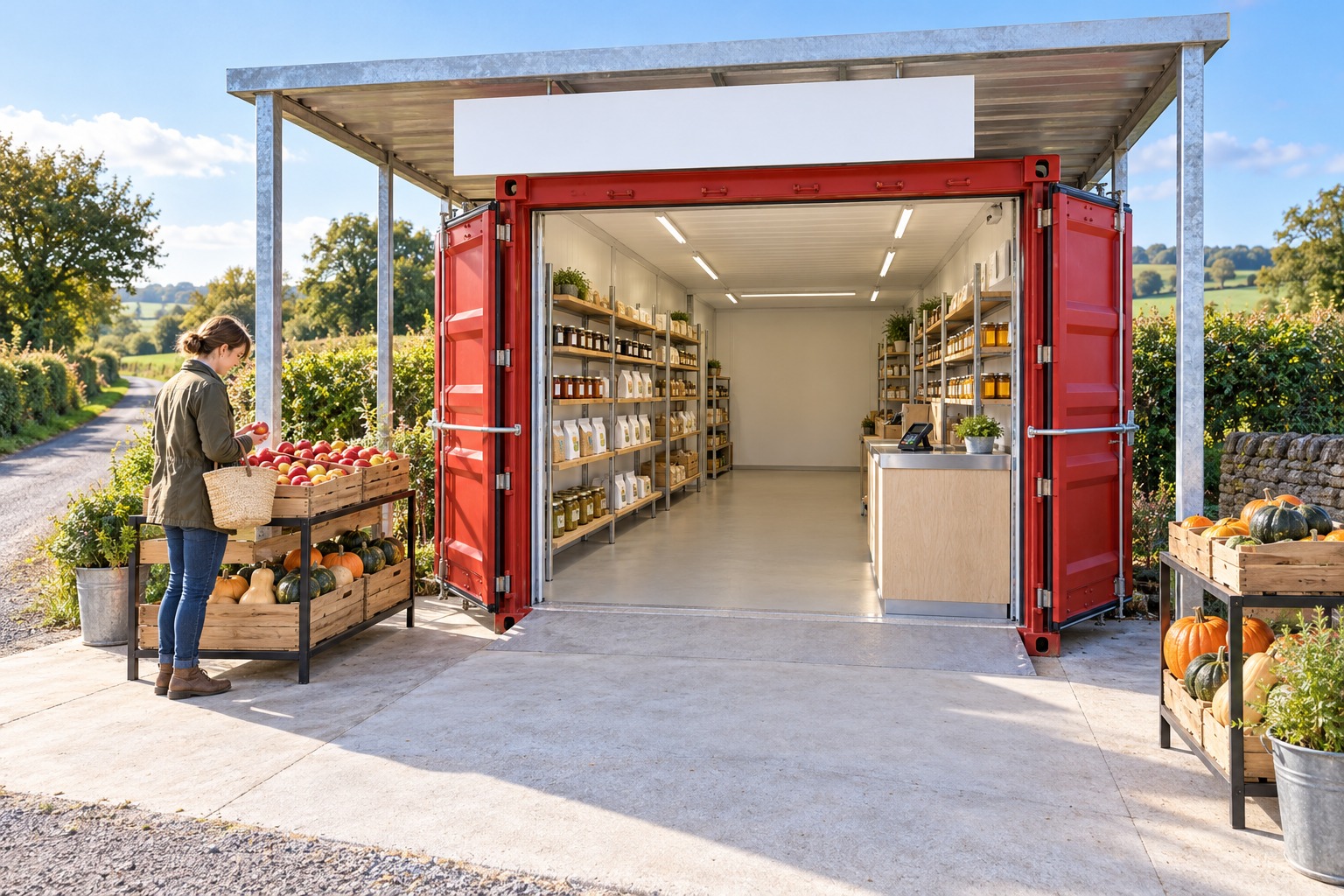
Image credit: pxef.com. AI-generated design concept. Access, stock conditions and installation details require project-specific review.
The shell is a standard 20-foot container, about 5.90 by 2.35 metres inside according to one shipping line’s nominal figures. A food shop needs walls that can be wiped down, so the proposal assumes a simple insulated, washable lining at 75 millimetres at each side and the closed end, plus 150 at the door end for the inner door frame. That gives a finished room of roughly 5.68 metres long and 2.20 metres wide. That width does most of the planning.
The first decision is where people come in. The obvious choice is the cargo-door end, because the opening already exists and avoids a new opening in a long wall, although the inner entrance still needs design and installation. With the doors open, the whole end of the container becomes a shopfront, and at closing time the steel doors swing shut over everything. The weakness is that the shop becomes a dead-end aisle. Customers walk in, turn round at the back and walk out the same way, passing everyone still browsing. The alternative is a wide opening in the long side, with shelves along the back wall and customers moving along the length outside under a canopy. That gives a much longer frontage and lets people pass each other easily. It also means cutting a large opening in the corrugated wall, which is one of the stiffening parts of the box, so it needs proper structural design, and a shutter or doors of its own to secure it at night. For a small shop on a tight budget, the end door wins. For a busier pitch where queues matter, the side opening may earn its cost.
This proposal uses the end door, and provides space to test the dead-end route. The first 1.5 metres inside are the counter zone. A payment counter sits on the right, leaving well over a metre and a half of clear floor beside it. A lowered counter section is proposed, with its clear floor space, approach and dimensions to be checked against the applicable requirements. Lowering the top alone does not establish an accessible sales point. Shelving then runs along both walls for 2.5 metres, 400 millimetres deep, stainless steel frames with pale timber shelves. That leaves an aisle of about 1.4 metres. The last stretch of the container has no side shelving at all, just a shallow shelf on the end wall. With the declared allowances, that rear space is 1,675 millimetres long before a 150-millimetre end shelf, leaving 1,525 by 2,202 millimetres clear in the empty drawing. It is intended for turning, but exact furniture, obstructions, approach and applicable requirements still need checking. A nominal circle on a plan is not an accessibility assessment.
Heavy and popular things go at hand height near the front, including flour bags and egg boxes, plus honey at eye level where people see it first. Slower lines go further back. Shelf heights should be tested with the intended customers, the packages and any obstructions in front. Popular stock within easy reach reduces the need for staff assistance; heavy sacks need a handling plan rather than simply a higher shelf.
Outside, a canopy on its own posts shades an apron in front of the open doors. In the morning, crates of apples and squash go out onto low stands under it, where people see them from the lane. The canopy has its own supports, foundations and wind-resistance design. Separating it from the shell does not remove structural questions, and its posts must sit outside the cargo-door sweep. When they’re open they need proper restraints to stop them swinging, and the route in has to stay clear. Councils treat shop canopies and awnings differently. In some places they need planning permission, and over a public pavement they may need permits and insurance. The local authority should see the plan before anything is ordered.
Temperature is the quiet issue in a steel box. Food safety agencies generally advise keeping shelf-stable foods somewhere cool, dry and out of direct sun, and the US agriculture department’s food safety service says temperatures below about 29 degrees Celsius are best. Home-preserving guidance from a university extension service suggests storing jars of jam somewhere cool and dark. A container in summer sun can get far warmer inside than that unless it’s insulated, ventilated and shaded, which is another reason for the lining, a reflective roof and the canopy. Actual stock temperatures need monitoring, with suitable cooling if passive measures cannot maintain the required conditions. Each product still needs its own storage instructions; a general ambient-storage recommendation is not a temperature limit for every food.
Egg storage needs a decision before equipment is bought. Different markets have different production, washing and retail-handling systems, so advice from another country cannot simply be transferred to this shop. The local food authority and supplier should confirm the required temperatures and handling routine. A fridge, if required, needs a suitable operating-temperature range, ventilation and electrical supply; it cannot simply consume the clear floor reserved for payment and entry.
The same goes for registration and licences. In England, Wales and Northern Ireland, a food business has to register with its council at least 28 days before trading. Rules like these vary from state to state and country to country, and nothing in this concept should be read as approval of any of them. Accessible entry is the other item to settle locally. A container on supports usually sits above the ground, so the step at the doors needs a ramp or a level platform designed to the relevant standard.
Closing up should take minutes. Crates from the apron need allocated storage outside the rear turning area. This proposal does not assume that customers will be gone whenever staff move stock, so a restocking routine must keep the entrance and turning space clear. The till holds as little cash as possible. Police crime prevention guides in Britain and the United States repeat the same advice: keep little cash, bank it often, have two people open and close, keep the shop well lit and make security measures visible. A shop that takes cards only removes most of the cash question, though some customers at a lane-end stall will still expect to pay in coins. Then the inner door closes, the steel doors swing shut and a shrouded padlock goes on. The shop becomes a container again until morning.
A small timber farm shop could be wider, warmer and easier to open up along its front. The container’s case is that it arrives as a single shell and can provide an enclosed shop when properly detailed. Its locks, openings and anchor arrangements need a security assessment, while any future move depends on the completed structure, services, lifting and transport. For a farm that wants to start small and keep the stock locked away at night, it may be a useful trade if the approach, browsing route and stock conditions work on the actual site.