A Container Garden Kitchen with the Grill in the Yard
The grill is usually the first thing people buy for an outdoor kitchen and the last thing they give enough space. It gets pushed against a wall, squeezed under a roof or parked beside the table, and the person cooking becomes an obstacle between everyone else and dinner. This garden-kitchen concept starts by giving the grill its own place in the yard. The container handles preparation, washing and storage. The cooking happens separately, under open sky.
That division makes the container useful without asking it to become a little restaurant. Think of a household that enjoys weekend lunches outside and wants somewhere to prepare vegetables, assemble plates and put everything away afterwards. The brief is a domestic garden kitchen, not a catering business. A turquoise steel shell, a bright serving opening and a few yellow stools make the preparation space part of the garden, while a freestanding barbecue occupies a separate hardstanding beyond it. A small dining area sits to the other side, where people can talk without gathering around the hot appliance.
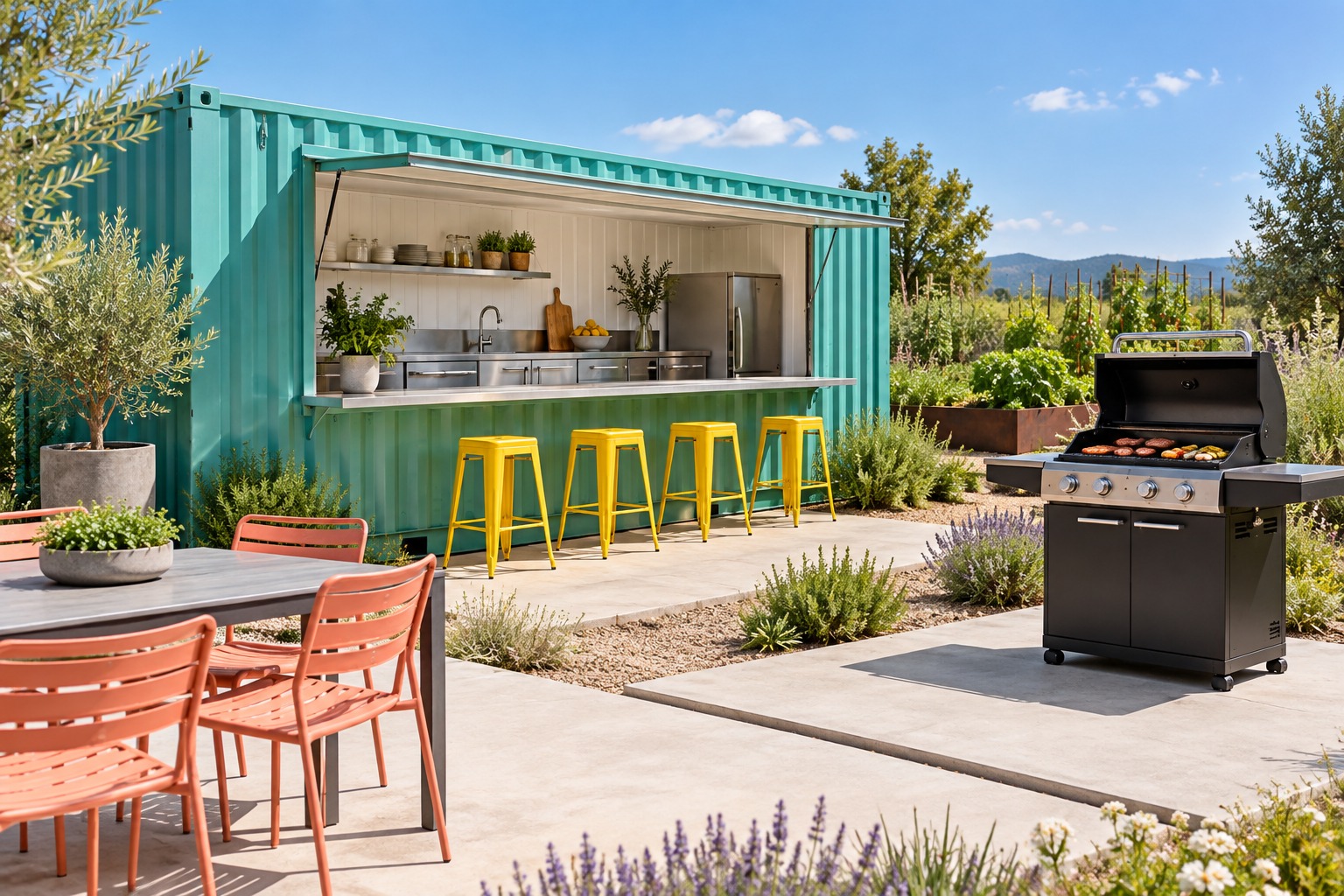
Image credit: pxef.com. AI-generated design concept. Appliance clearances and installation details require site-specific design.
The illustration is an AI-generated design concept. It establishes the relationship between the preparation room, grill and table, rather than a measured installation. No appliance model, fire clearance, structural reinforcement or drainage connection has been specified. Those decisions belong to the actual site and equipment. The point worth taking from the picture is the separation of activities: prepare inside, cook outside and serve somewhere that does not obstruct either.
Inside the container, the most valuable surface is an uninterrupted preparation counter. A stainless worktop gives the concept a practical industrial character, with closed storage underneath for utensils and serving dishes. A sink belongs at one end rather than in the middle of the only useful cutting area. A dedicated place for clean plates belongs at the other. It is easy to fill a small kitchen with appliances and leave nowhere to put down the tray that has just arrived from the house. This proposal would rather have less equipment and a counter that remains usable.
The serving opening faces the social part of the garden. It lets someone preparing lunch remain in the conversation and provides a place to pass out drinks or a finished salad. The stools are for that edge of the activity, not for the space between the counter and the grill. A guest should be able to get up without stepping into the cook’s working position. If the yard cannot accommodate those movements, the stools are the first thing to remove. A clear route is more valuable than two extra seats in an already crowded kitchen.
The opening is also a significant alteration to a container wall. Its attractive thin frame in a rendering does not show how the shell is supported. A structural designer needs to establish the opening, reinforcement and any shutter or door arrangement, and the weathering detail needs to keep rain out when the kitchen is closed. The same applies to the serving ledge: support, drainage and cleaning access need resolving together. A large opening is a deliberate trade of wall space and construction work for a stronger connection with the yard.
The grill stands on a separate, level, noncombustible surface. It is outside the container, outside its serving opening and away from the dining chairs. It has open sky above rather than a roof borrowed from the preparation area. The actual separation from the building, planting and anything that can burn must follow the selected appliance’s instructions and applicable local requirements. A steel container wall does not make the surrounding window frames, seals, furniture or vegetation irrelevant. Nor does an open container door turn its interior into an appropriate place to operate an outdoor barbecue.
Weather is the compromise this arrangement accepts. A grill in the yard cannot be made rainproof by casually rolling it beneath an overhang or into the container. The owner needs an alternative meal plan when conditions are unsuitable. That sounds less glamorous than an all-weather outdoor kitchen, but it is a more useful brief than an attractive enclosure with an unresolved combustion problem. If covered cooking is essential, it should be designed around equipment specifically suitable for that setting, rather than improvised around this concept.
Food moves between three places, so the handoff deserves thought. Raw ingredients travel from their cold storage to preparation and then to the grill. Cooked food returns on clean plates with clean utensils, not on the tray that carried raw meat. A food thermometer belongs with the cooking tools because a browned surface does not establish that the centre is cooked. These habits are easier to maintain when the counter has distinct landing places and enough room to keep clean items out of the way. The outdoor layout should make good handling convenient rather than depend on everyone remembering where the last plate has been.
Cold storage is another choice to make honestly. This proposal does not assume that an ordinary indoor refrigerator can live indefinitely in a hot, damp container. If a fridge is wanted, its operating conditions, ventilation and electrical installation need checking against the actual model. For occasional lunches, using the house kitchen for refrigerated ingredients may be the simpler arrangement. The relevant question is how far that journey is and whether it crosses the dining area repeatedly. A garden kitchen that depends on constant trips through the house may be solving the wrong problem.
Water and cleaning decide whether the room remains pleasant after the guests leave. The sink needs a suitable water supply and an approved drainage route. The presence of a garden tap is not a complete plumbing design, and rinse water does not simply disappear into the nearest planting bed. A local plumber should resolve the connection, seasonal conditions and any required protection. Electrical equipment and lighting need the same attention to outdoor exposure and the way the kitchen is cleaned. None of those services becomes simpler merely because the worktop fits neatly inside a box.
The colours can stay cheerful without making the room precious. Turquoise steel, stainless counters and yellow seating suit equipment that is wiped down, moved and used. Closed storage keeps serving dishes from becoming a display that needs cleaning before every meal. Herbs can grow nearby without surrounding the grill or narrowing its working area. The dining table belongs where the cook can join everyone with a plate, rather than remain behind a counter for the whole afternoon. This is a garden kitchen, after all, not a stage on which one person performs while everyone else watches.
A simpler counter beside the house and a good grill might do the same job with less building work. The container earns its place when enclosed preparation and storage are genuinely useful and the yard can comfortably accommodate the separate cooking area. Keep that test in view. The strongest version of this idea is not a container packed with every possible kitchen appliance. It is a clear sequence from preparation to grill to table, with enough space for lunch to remain enjoyable for the person making it.