What the Delivery Truck Needs Before the Container Arrives
The most expensive part of an inexpensive container can be the last turn into the property. A seller’s photograph shows a box in an open depot. The buyer imagines that box beside the garden wall. Between the two are a narrow lane, a gate, a soft verge and a delivery vehicle that occupies considerably more space than its load. That missing journey belongs in the purchase decision, before the shell is reserved and certainly before the garden is landscaped around its intended position.
Consider a hypothetical site with a 20-foot container already placed beyond an open gravel approach. The illustration deliberately shows the finished position, with no truck lifting or unloading it. It is a way to discuss the relationship between entrance, route and destination, not evidence that the route could carry a particular vehicle. The questions below are for the supplier, haulier and relevant site specialists. They are not instructions for setting up a crane or deciding what an untested piece of ground can support.
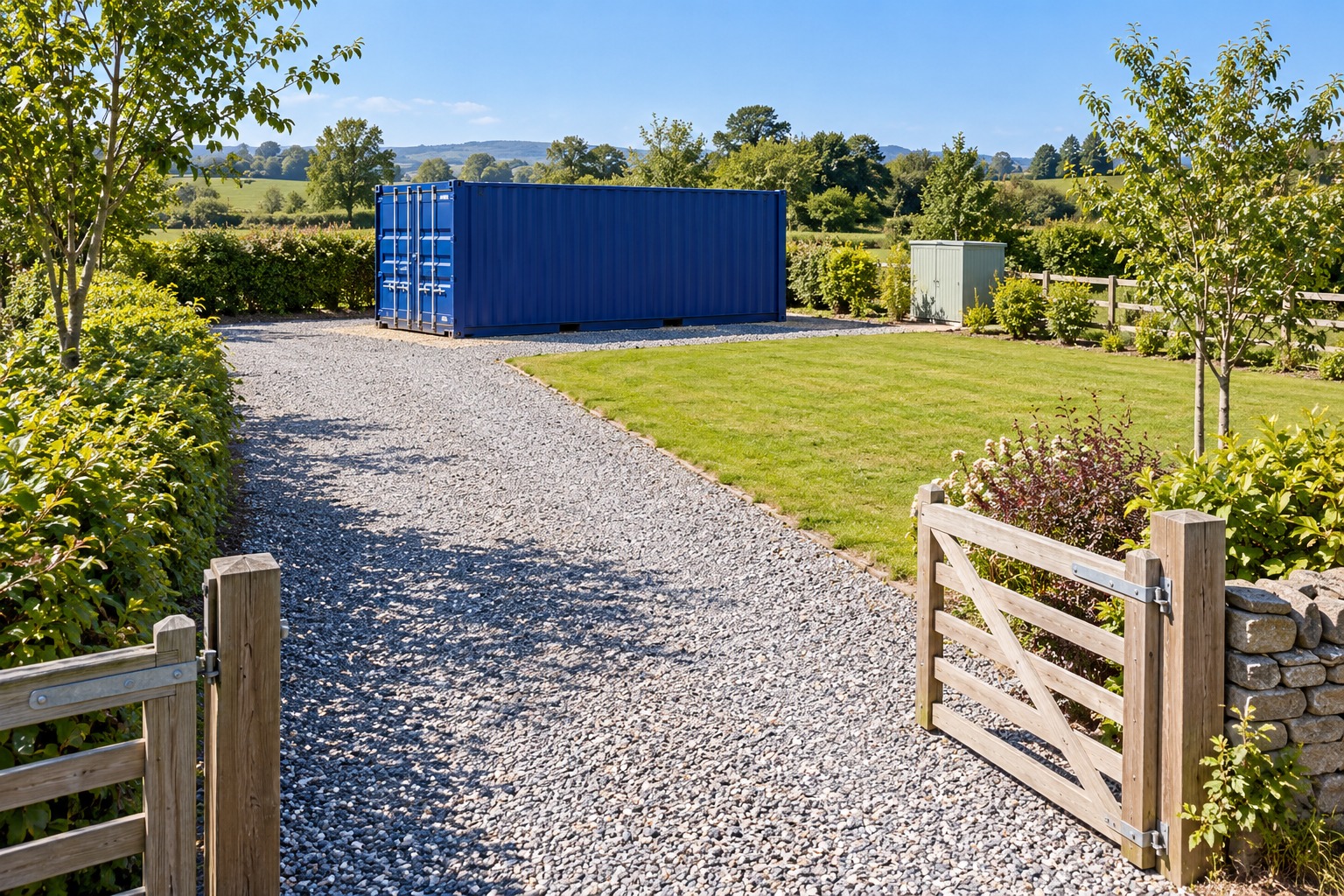
Image credit: pxef.com. AI-generated design concept. This placed-container view does not demonstrate vehicle access or ground capacity.
Start by finding out what the word delivery includes. A quotation may cover transport to the address but leave unloading to the customer. Another may include a self-unloading vehicle, subject to a suitable site. A third may assume separately arranged lifting equipment. Those are different services even if the shell and road distance are identical. The useful question is what happens between the vehicle reaching the property and the container reaching its final position, and who is responsible for each part of that movement.
Suppliers describe several ways of doing the job, including tilt-bed delivery, flatbed transport requiring unloading equipment and crane-assisted placement. A description of the method is not enough to approve it for a site. The vehicle needs room to reach its working position and leave again, and the proposed method brings its own operating envelope. Ask the contractor to assess the actual route and destination against the equipment they intend to send. Do not try to turn a marketing diagram into a lifting plan.
Published access figures are useful mainly because they show that the container’s footprint is the wrong starting measure. Suppliers can quote different straight-line requirements for the same nominal box length because their vehicles and methods differ. Even one supplier’s figure may be conditional on a particular arrangement. Rather than borrowing a clearance from another company’s page, ask for the dimensions and constraints of the booked vehicle, and have the route checked on that basis. This article intentionally supplies no universal gate width or straight-run allowance.
The route begins before the gate. A delivery driver may have to turn off a narrow road, pass parked cars, negotiate a bend or reverse into the entrance. A wide gate set directly beside a sharp turn can be less useful than it appears in a frontal photograph. The haulier needs to understand approaches, turning movements and any restrictions along the route, including the way out. Permissions to use adjoining land or temporarily control traffic cannot be assumed just because the container itself will remain on private property.
Photographs should explain relationships, not simply show the attractive final spot. An approach view, the gate from both directions and the full path to the placement area give the reviewer more to work with. A measured site survey may still be needed, and photographs cannot establish bearing capacity or reveal every buried service. Tell the contractor what is known, what is uncertain and what has changed since the images were taken. A delivery plan based on last summer’s open yard is no help if a new wall now occupies the turning space.
Overhead constraints need separate attention. Tree branches, building projections and utility infrastructure can affect the transport route and the working position differently. A vehicle passing beneath something is not the same situation as equipment operating beside it. Any electrical-line issue belongs with the contractor and relevant utility, not a distance estimated from a photograph. The owner should identify potential constraints early and let competent people establish the requirements. Removing a branch at the gate does not settle the rest of the overhead route.
The ground is equally easy to misread. A neat gravel finish does not tell you what is beneath it, and a dry lawn in a photograph does not promise the same condition after rain. Underground services, drainage features, made ground, edges and adjacent structures all belong in the site information supplied for assessment. The delivery working area and the permanent support design are related questions, but one is not evidence for the other. A base suitable for the finished building does not automatically approve the access route for a loaded vehicle.
Door orientation should be agreed before loading and dispatch. With some delivery arrangements, the way the container is carried determines which way the cargo doors face when it is set down. That affects the later entrance, approach and any canopy. A buyer should confirm the final position and orientation in a form everyone understands, including which face is intended to meet the path. Turning the box after arrival may require a different operation rather than a small adjustment made by the driver.
Conversion adds another layer. The load being delivered may be a bare shell or a completed room with glazing, lining and services. Its actual weight, handling provisions and vulnerability to transport damage need to be known by those planning the work. The original transport fittings should not be treated as proof that every altered building can be moved in the same way. A proposed future relocation also needs to survive the design of the base, connections, landscaping and access, not merely appear in the sales description as portable.
Responsibility should be clear enough to survive an awkward morning. Who confirms that the route is suitable? Who arranges permits or access agreements? Who checks that the receiving works are ready? What happens if weather or changed conditions prevent the agreed operation? The written order should explain exclusions, cancellation or failed-delivery arrangements and the point at which the customer accepts the placement. These are commercial questions to resolve with the parties involved, rather than a reason to improvise when the truck is already waiting outside.
For lifting operations, competent planning and supervision are fundamental. That does not mean the owner needs to design the lift; it means the owner needs a contractor whose service and responsibilities match the job. Anyone separately hiring equipment should understand that providing a machine is not necessarily the same as providing a complete managed operation. The chosen arrangement must address the actual risks and site, with people kept clear according to the contractor’s plan. Watching from beside the load is not a useful form of project management.
Sometimes the result of all this is that a different building is the better purchase. A structure assembled on site may avoid a difficult transport movement, while a different container size or location may make the project practical. That conclusion is valuable before money is committed. The successful delivery is not the one with the most impressive machine in the photograph. It is the one whose route, method, responsibilities and final position were understood before the vehicle left the depot.