When Reusing a Container Is Not the Greener Choice
A shipping container arrives with an environmental story already attached. Steel has been made, a box exists and giving it another job feels better than making something new. Sometimes that is a useful starting point. It is not a conclusion. The finished project also contains transport, site works, windows, insulation, lining, services and years of use. If the claim stops at the reused shell, it has stopped before most of the decisions the owner still has to make.
Imagine a modest garden office for one person working through the year. The pale green container in the illustration is one possible answer to that brief. Its colour, timber screen and planted setting establish an architectural mood, not measured environmental performance. No carbon calculation has been carried out for it. The useful comparison would be with another way of providing the same working conditions, for the same expected period, at the same site. It might be a small framed garden room, a conversion within the house or no new building at all.
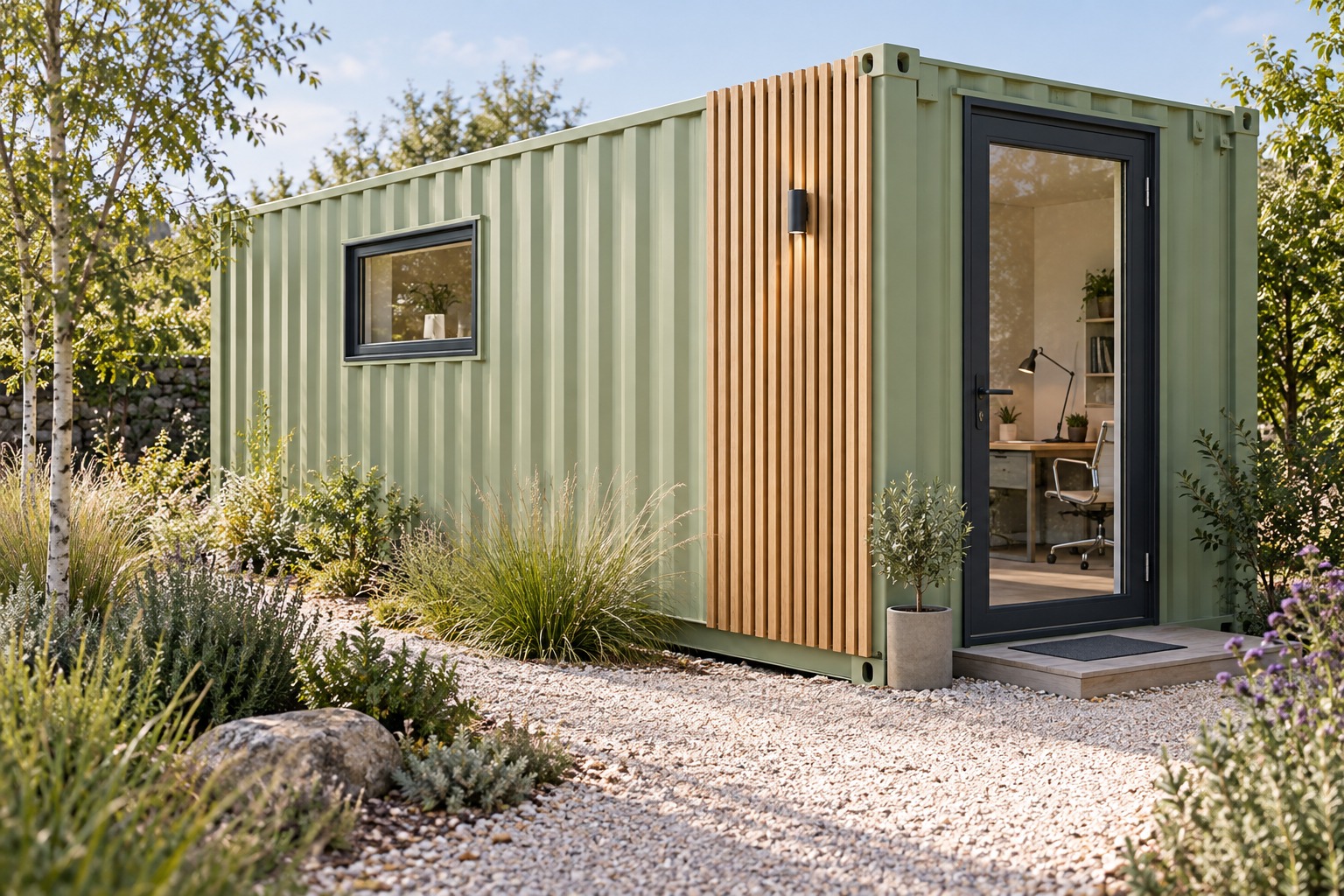
Image credit: pxef.com. AI-generated design concept. No environmental performance has been measured for this proposal.
The first question is what is actually being reused. Ask about the shell’s history, current condition and realistic remaining uses. A recently manufactured unit that has made a limited journey is not automatically a discarded object awaiting rescue. Nor is a damaged, cheap shell necessarily a good reuse candidate. Its assessment, repair and conversion may be substantial. The provenance needs to be described honestly without assigning either environmental virtue or failure from a photograph of a few dents.
Reuse and recycling are different routes. Reusing a component retains it for another purpose; recycling processes material into a new material or product. Both can have value, but they are not interchangeable claims. A container conversion should not be credited with avoiding an invented disposal fate if the actual alternative for that shell was continued freight service, storage or material recovery. The counterfactual matters. That is a question for an assessment with evidence, not a dramatic statement that every purchased box has been saved from landfill.
Then look at what survives the design. A proposal with modest openings and a useful existing end frame retains a different amount of the original object from one that removes most of the walls and adds extensive new structure. Neither arrangement can be ranked from appearance alone, but the material schedule should reveal the difference. If the concept needs so much alteration that a new frame supplies much of its function, the environmental argument needs to follow that actual construction rather than the familiar outline left around it.
Transport is another input, not a universal verdict. A locally available suitable shell and a complicated journey involving several stages are different scenarios. So are a bare-shell delivery and transport of a completed building. Record the real distances, vehicles and handling rather than assuming that one journey is negligible or that any long journey ruins the project. The same principle applies to the alternative building’s materials. Comparing the container’s entire supply chain with only the final delivery of a timber room would stack the argument before the calculation began.
The fit-out needs to be counted on both sides. The container still needs an envelope suited to its climate, and the framed alternative needs one too. Windows, insulation, finishes and equipment should be compared at an equivalent level of function, not quietly included in one option and omitted from the other. Environmental product information may help, but the material quantities and installation choices have to match the actual proposal. A generic benefit for recycled content does not answer what this collection of products will do over its life.
Daily operation also matters. An office used throughout the year should be comfortable without depending on an unexamined heating or cooling arrangement. The steel shell alone tells little about the performance of the completed room, because the envelope, openings, shading, ventilation, equipment and use all intervene. The comparison should use a common climate and realistic working schedule. A favourable result under one set of assumptions is not a promise for a different garden, a different owner or a building left conditioned all weekend.
A published life-cycle study of a container home illustrates the need for that wider view: its assessment considered construction and use rather than simply counting reused steel. It does not supply a ready-made saving for this office. A house has different occupancy and services, and any study’s location, energy assumptions, material choices and analysis period affect its result. Research is useful for identifying what to examine. It becomes misleading when a result from one case is pasted onto every steel box with a desk inside.
Service life is particularly easy to overstate. A comparison should not assume that the preferred option lasts indefinitely while its competitor is replaced unusually quickly. State how long the building is expected to provide the required service, what maintenance and replacements are anticipated and what evidence supports those assumptions. Coatings, seals, equipment and finishes may have different replacement cycles from the shell. Access for inspection and repair can therefore be an environmental design question as well as a practical one, especially where the lining conceals the material being celebrated.
End-of-use claims deserve the same restraint. A building may be described as movable or recyclable without a workable plan for either. Could it leave the site after the garden has matured? Can services be disconnected and components separated? Will materials remain identifiable, and will a future owner have the information needed to maintain them? Those questions do not establish a guaranteed second life, but they help distinguish a reversible design intention from an adjective in a brochure. Possible future benefits should not casually erase the impacts incurred today.
Carbon is not the only environmental issue. Resource use, waste, water and potential effects on the site can also matter, and a favourable result for one measure is not a universal green certificate. Even within a carbon comparison, the boundaries and assumptions need to be visible. A narrow, supportable statement about retained material is more useful than calling the entire building sustainable. A planting scheme and a light-green paint finish can make an office pleasant; neither supplies missing evidence about its production or operation.
There is also a simpler test that rarely appears in a sales pitch: whether the new building is needed. A suitable spare room, an existing outbuilding or a shared workspace might provide the required function with less new work. That is not an automatic answer for a household that needs separation or has no available room. It is a reasonable option to include before comparing two newly constructed garden buildings. The project brief should be allowed to change if a less elaborate arrangement meets the same need.
Reusing a container can be worthwhile when a suitable shell earns a long and useful second job without excessive compromise. It can also be the wrong choice when the conversion, site and use demand more than a practical alternative. The honest answer is conditional because the project is conditional. Ask what has been retained, what has been added, what service is being provided and what it is being compared with. That is a much better environmental story than assuming the steel did all the work before the design started.