A Container Reading Room Where the Books Come First
People who own a lot of books tend to dream about a room just for them. Shelves from floor to ceiling, one good chair, a lamp and a door that closes. A container in the garden seems like a neat way to get it, with a long room already built, walls ready for shelving and a lockable door. What the dream leaves out is that books are heavy, that paper is fussy about damp, and that an uncontrolled enclosure can expose them to changing conditions. A reading room in a container can work very well. It just has to be designed for the books first and the reader second.
This concept is for a retired teacher with about two thousand books, from paperbacks to large art books, currently stacked two deep on every wall of the house. She wants them out where she can see their spines, plus a comfortable chair by the light, a small desk for writing letters and somewhere to put a cup of tea that isn’t on a book.
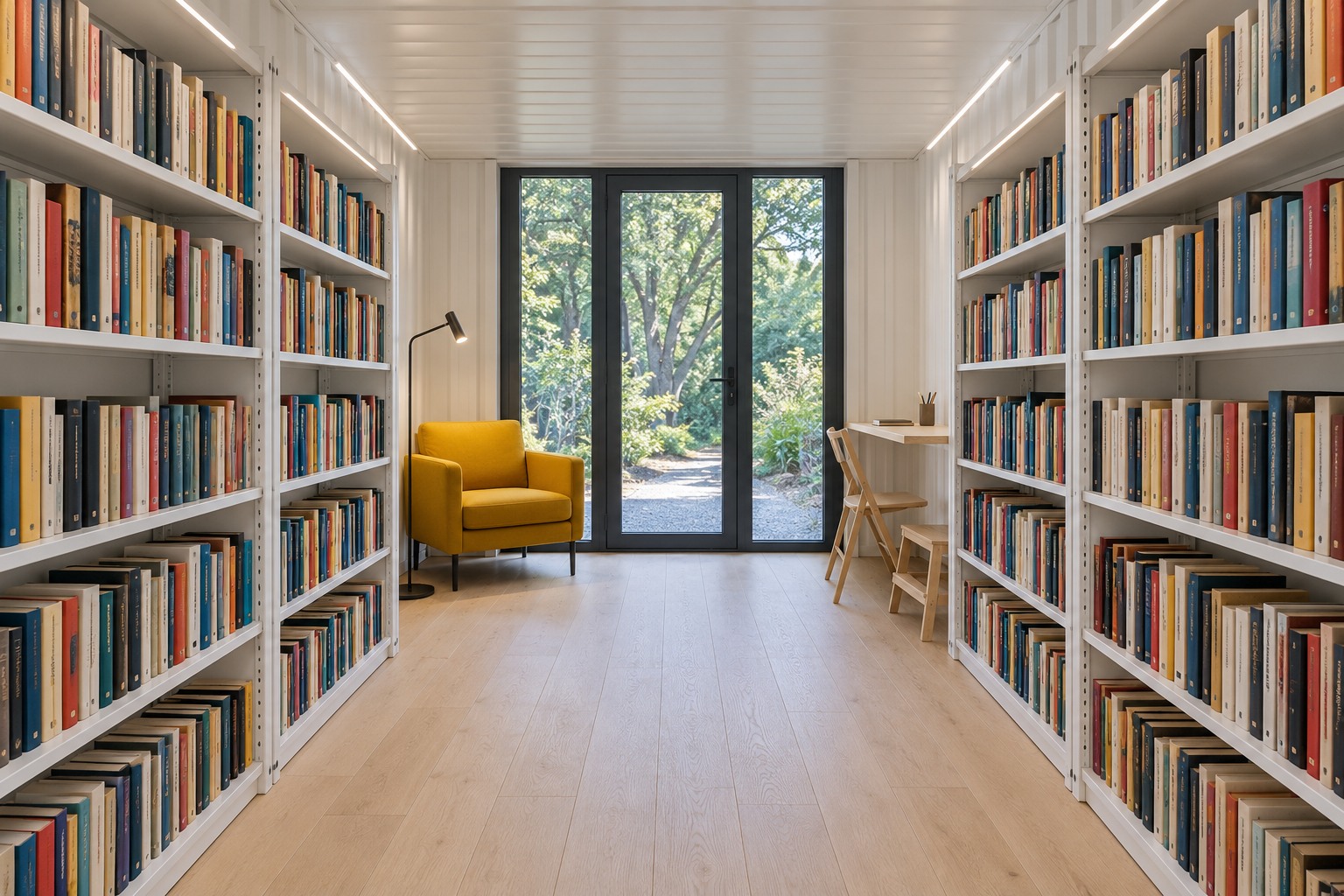
Image credit: pxef.com. AI-generated design concept.
The shell is a standard 20-foot container, about 5.90 by 2.35 by 2.39 metres inside according to one shipping line’s nominal figures. With an illustrative 75 millimetres of insulated lining on each wall and the closed end, 150 at the glazed end, and 60 and 75 for floor and ceiling, the finished room is roughly 5.68 metres long, 2.20 metres wide and 2.26 metres high. As with any container room, the finished width is what decides the plan.
Books set their own shelf depth. Woodworking references put typical bookshelves at 200 to 300 millimetres deep, and most novels and paperbacks are happy at the shallow end. The proposal uses 250 millimetres on both long walls and across the closed end, with one deeper bay of 350 millimetres near the desk for the art books. Allowing a small gap behind the shelving, that leaves a central aisle about 1.65 metres wide. That is empty-floor width before the reader, chair movement or equipment. The library step needs a parked position outside the route.
The shelves are steel rather than timber. The Library of Congress prefers metal shelving for books because acids in some woods can migrate into paper over time, and powder-coated steel uprights with adjustable shelves suit the industrial shell anyway. Each bay spans about 800 millimetres between uprights. The shelf product, span and rated loading must suit the actual books; a sag calculation for a timber board does not specify a steel shelf system. The lowest shelf sits about 150 millimetres off the floor, as archival shelving advice recommends, so a spill or a damp floor doesn’t reach the books. Six shelves rise from there to a little under two metres, and a step reaches the top.
Then the weight, which is the number nobody expects. Running along both long walls and the end, the shelving gives roughly 9.7 metres of shelf per level, or close to 60 metres in total. A woodworking reference suggests that books weigh somewhere around 30 to 60 kilograms per metre of shelf, depending on what they are, and a booksellers’ association article recommends simply weighing a foot of your own books to find out. Either way, a full room could easily hold somewhere around two to three and a half tonnes of books, as much as the empty container weighs or more. Those are rough inventory scenarios, not a rated capacity for this floor. The container floor, its supports and the ground beneath them should be checked by a structural engineer before the shelves go in. Tall units need suitable stability and anti-tip provisions. American safety campaigns on furniture tip-overs say to anchor bookcases and keep heavy items low. In a container, the fixing method into the lined steel wall is a question for whoever builds the shelving.
Now the air, which matters more than the weight in the long run. Conservation guidance from libraries and archives agrees on the broad picture. Books and paper do best at moderate humidity, roughly 30 to 60 percent according to the Northeast Document Conservation Center, at temperatures people find comfortable, about 18 to 22 degrees Celsius for rooms that people and books share. Those are general preservation starting points, not a guarantee for every collection. The envelope and services need to control actual conditions, and a logger can show how the room behaves over time. A dehumidifier may be appropriate, but does not replace ventilation or prove that cold surfaces remain dry. A proposed 25-millimetre gap behind shelves permits space for inspection and air movement; it is not a validated condensation remedy. Important or vulnerable books need advice appropriate to their materials and value.
Light is the tension in a reading room. Readers need plenty of it on the page. Lighting standards for library reading areas call for around 500 lux, and guidance from British lighting engineers suggests 300 lux on a desk and more for older readers. Books, on the other hand, want the dark. Canada’s conservation institute notes that ultraviolet light yellows paper and that reducing total exposure matters more than any filter. The answer is to put the light where the reader is. The armchair and the small desk sit at the glazed end, which gets blinds and a UV-filtering film, and a good reading lamp aimed at the page does the rest. The shelves further in are intended to avoid direct sun, and their lights stay off when nobody is choosing a book.
Pests are the quiet risk in a garden building. A conservation leaflet on pest management from the same New England centre lists the usual suspects. Silverfish eat the starch in paper and bindings, booklice feed on mould and signal damp, and carpet beetle larvae go for protein materials like leather. Its advice is practical: keep the room cool and below 70 percent humidity, seal gaps, limit live plants, check incoming books, and put out dated sticky traps to see what’s around. English Heritage adds a warning about grey silverfish, which can breed in drier conditions than the common kind, so dryness alone won’t keep them out. A container’s tight shell is an advantage here, as long as door seals and cable holes are kept tight.
What about the reader? The armchair faces down the room, so the shelves are the view, with a side table and the lamp beside it. The desk sits across the corner opposite, small enough to leave the aisle clear, with a drawer for writing paper and a power socket for a laptop. A narrow rug softens the floor and the acoustics. When unoccupied, retained steel doors could close over the glazing if their sweep and restraints are designed for it. Occupied escape and security need their own arrangements.
A purpose-built garden room can offer a different width and envelope, but material choice alone does not establish a safe collection environment. Precious or rare books may belong in a professionally assessed storage setting rather than either untested garden proposal. For a well-loved working library that wants to come out of the cupboards, a container can do the job, as long as its weight is checked, its air is kept steady and its light stays on the page instead of the spines.